WHAT HAPPENED TO NVIDIA STOCK
NVIDIA has just pushed back strongly against the “AI bubble” narrative with one of the most powerful quarters delivered by a global blue chip in recent years. Even so, the stock fell sharply after the earnings announcement.



What NVIDIA Announced
NVIDIA reported its fiscal Q4 2025 results on 26 February 2026, posting record figures that exceeded market expectations. Revenue came in well above analyst forecasts, and earnings per share were also solid. In addition, the company’s guidance for the next quarter pointed to revenue meaningfully higher than consensus estimates. Despite these strong numbers, the share price declined after the release.
Reaction in NVDA Shares
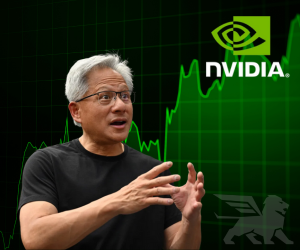
Although both the results and the forward guidance were robust, NVIDIA shares dropped by more than 5% on the day of the announcement and closed clearly below the opening price. The decline came even after an initial upward move immediately following the earnings release.
The fall in NVDA was significant enough to weigh on major technology indices, which ended the session in negative territory. This suggests that the reaction reflected broader market positioning and sentiment, rather than being limited to company-specific concerns.
Why the Stock Fell Despite Strong Results
Several technical and market-related factors help explain why the share price moved lower despite record performance:
- Very high expectations: Much of the positive surprise had already been priced in ahead of the results, limiting the upside impact once the numbers were confirmed.
- “Sell-the-news” activity: Investors who bought shares before the event used the announcement as an opportunity to take profits, creating short-term selling pressure.
- Concerns about sustainability: Some market participants questioned whether current levels of AI-related capital spending can be maintained over the long term.
- Elevated valuations: NVDA and the broader technology sector were trading at demanding multiples, which may have triggered additional selling around key technical levels.
Overall, these factors contributed to a more cautious market reaction than the strong fundamentals alone might have suggested, resulting in a noticeable post-earnings correction.

NVIDIA in the Semiconductor Industry Today
NVIDIA holds a central position in the global semiconductor industry, not because it owns fabrication plants, but because it designs some of the most in-demand processors for accelerated computing. Its value proposition is built on high-performance architectures (mainly GPUs and AI accelerators), a fabless business model that outsources manufacturing to leading foundries such as Taiwan Semiconductor Manufacturing Company (TSMC), and a strong software ecosystem that makes its hardware more powerful and harder to replace.
In terms of the value chain, NVIDIA operates in one of the most differentiated segments: advanced chip design and platform integration (hardware combined with libraries and development tools). This approach allows the company to maintain high margins, evolve its architectures quickly, and adapt to technology cycles increasingly driven by artificial intelligence training and inference workloads.
From GPUs to AI and Data Centre Infrastructure
For many years, NVIDIA was closely associated with graphics processing and gaming, and later with cryptocurrency mining. Its strategic transformation became clear when GPUs proved ideal for large-scale parallel processing, a key requirement for modern AI and high-performance computing. Since then, the data centre segment has become the main driver of its industrial importance. The chip is no longer a standalone component but part of a broader accelerated computing infrastructure.
In practice, NVIDIA’s technology powers systems that train advanced AI models, process massive volumes of data, and support compute-intensive workloads. This makes the company a strategic supplier not only to global technology firms, but also to sectors such as financial services, healthcare, energy, automotive manufacturing, and scientific research—areas that are increasingly investing in AI capabilities across the Middle East and North Africa.
The Platform Advantage: Hardware, Software and Tools
A decisive competitive advantage for NVIDIA is that it competes as a platform, not just as a chip vendor. CUDA, together with a wide range of optimized libraries and frameworks (for deep learning, computer vision, simulation, and data science), acts as a productivity layer for developers and engineering teams. It reduces integration friction, shortens time-to-market, and encourages technology stacks to standardize around NVIDIA hardware.
This creates a degree of technical dependency. The more software is built and optimized for NVIDIA systems, the more costly and complex it becomes to migrate to alternative solutions. In the semiconductor sector, where performance and efficiency are critical, software capability is increasingly as important as the silicon itself.
Strategic Positioning in the Global Value Chain
As a fabless company, NVIDIA focuses its resources on research and development, architecture, and system design, while relying on top-tier global manufacturers for production. In a market where advanced process nodes and sophisticated packaging can create supply bottlenecks, this model combines innovation capacity with access to cutting-edge manufacturing technology.
At the same time, NVIDIA has expanded beyond GPUs into high-speed networking for data centres, interconnect technologies, and integrated solutions aimed at optimizing the entire computing system—not just the chip. This system-level approach aligns with the broader direction of the industry, where real-world performance increasingly depends on how compute, memory, networking, and software work together.
Direct and Indirect Competitors
In semiconductors, competition can take different forms: competing directly in GPU sales, offering alternative AI accelerators, providing integrated cloud solutions, or replacing parts of the computing stack such as CPUs, memory, or networking components. It is therefore useful to distinguish between direct competitors (same product category and use case) and indirect competitors (partial substitutes or rivals for platform and infrastructure control).
Direct Competitors
- AMD: Competes in GPUs and data centre accelerators, focusing on performance per dollar and alternative ecosystem strategies.
- Intel: Competes with its own GPUs and AI accelerators and integrates computing into broader enterprise platforms.
- Google: Competes through proprietary AI accelerators designed for specific workloads within its cloud services.
- Amazon Web Services: Develops in-house AI chips optimized for training and inference within its cloud infrastructure.
- Microsoft (and other hyperscalers): Invest in proprietary accelerators and AI stacks to reduce reliance on external hardware providers.
More Indirect Competitors
- Apple: Competes indirectly through integrated GPUs and machine learning engines in its system-on-chip designs.
- Qualcomm: Competes in energy-efficient computing and AI acceleration in mobile and edge environments.
- Arm: Provides a widely adopted CPU architecture that enables alternative computing platforms.
- Broadcom: Competes indirectly by supplying critical networking and connectivity components for data centres.
- FPGA and specialized accelerator companies: Compete in niche areas where configurable or dedicated hardware may offer efficiency advantages for specific workloads.
- Memory manufacturers (such as DRAM and HBM suppliers): While not direct substitutes, they influence availability and cost structures of key AI system components.
- Companies developing in-house chips: Compete by designing proprietary hardware to reduce costs, secure supply, and control their technology stack.
NVIDIA Outlook
In this final section, we focus on the implications: how the quarter reshapes the narrative around AI capital expenditure, which levels and scenarios traders may use as reference points, and how different investor profiles might frame risk from here—while noting that this is general commentary and not personalized financial advice.
The Updated AI Growth Story
Before this quarter, it was still possible to argue that the AI infrastructure boom was strong but potentially fragile—dependent on hyperscaler budgets, export policies, and capital allocation decisions. After these results, that argument appears weaker. Hyperscalers are not only maintaining spending; they are accelerating it into 2026. The Sovereign AI pipeline has doubled quarter-over-quarter, and full Blackwell systems are largely committed through 2026. This looks less like a burst bubble and more like the middle phase of a sustained investment cycle.
Importantly, NVIDIA’s internal economics continue to scale effectively with demand. Gross margins remain around the mid-70% range, operating expenses are growing more slowly than revenue, and the company continues to build full-stack systems and software layers on top of its silicon. Each incremental dollar from the data centre segment is therefore not only large but highly profitable. If Blackwell margins exceed expectations—as management has hinted—the company’s structural earnings power may be stronger than many pre-results models assumed.
A Practical Framework for Investors
With this updated information, how might different types of market participants approach NVIDIA without assuming perfect foresight?
Long-term fundamental investors: May see the recent quarters as confirmation that the AI infrastructure cycle could extend into 2026–2027 at elevated levels. Focus should remain on volumes, backlog visibility, supply constraints, and software monetization rather than short-term share price movements.
Macro and sector allocators: Should recognize that NVIDIA has effectively reset expectations for the broader AI theme. Structural underweights in accelerators and related segments now carry higher opportunity risk, though position sizing remains crucial.
Options traders: Need to account for a different volatility environment. Earnings events increasingly resemble macro catalysts, and defined-risk strategies may be more appropriate than unhedged directional bets.
Retail investors buying pullbacks: The quarter validated the longer-term thesis more than the short-term timing. The question shifts from “Is AI real?” to “How much single-stock exposure fits within a balanced portfolio?” Diversification remains essential.
Risks Still Matter
After such a strong quarter, it is tempting to assume the growth story is secured. That would be premature. Export restrictions could tighten further. Competing architectures—from hyperscaler-developed chips to alternative accelerators—may gradually capture market share. Infrastructure bottlenecks in networking, cooling, or power supply could delay deployments even if demand remains strong.
There is also the simple issue of scale. NVIDIA does not need to miss expectations to experience volatility; it only needs to grow slightly below the most optimistic projections. Multiple compression tied to slower growth can be just as impactful as a direct earnings shortfall. Strong results do not eliminate the need for disciplined risk management—they make it even more important.
A Renewed Conclusion
So what happened to NVIDIA shares? In short, they followed a classic sentiment cycle: an initial surge to new highs and symbolic milestones, followed by a correction driven by positioning and headlines that revived debate about whether AI capital spending has peaked.
The stock has shifted from being “a story supported by numbers” to “numbers shaping the story.” That does not mean a straight-line path ahead, nor does it remove risk. For now, however, the market’s message is clear: NVIDIA has not merely absorbed concerns about a slowdown—it has continued to push forward.